Home Buying Closing Costs in India: Stamp Duty, Registration & GST Explained (2026)
Stamp duty, registration, and GST can add 8-10% on top of your property price. Full state-wise breakdown and a step-by-step calculator to budget correctly.
Priyanka Soni
5 Jun 2026
You found the perfect apartment. ₹80 lakhs. You have ₹20 lakhs saved for the down payment. The bank approved your loan for ₹60 lakhs.
The math works. You are ready to sign.
Then the builder hands you the final bill:
- Property price: ₹80,00,000
- Stamp duty: ₹4,80,000
- Registration: ₹80,000
- GST: ₹1,08,000
- Maintenance deposit: ₹1,00,000
- Legal fees: ₹50,000
- Loan processing fee: ₹30,000
Total: ₹88,48,000
You need ₹8.48 lakhs more than you thought. Your ₹20 lakh down payment is not enough. You are ₹8 lakhs short.
This happens to thousands of first-time homebuyers every year. They budget for the property price and the down payment. They forget about the closing costs.
Here is a complete breakdown of every cost you will face when buying a home in India, and how to estimate them before you start house hunting.
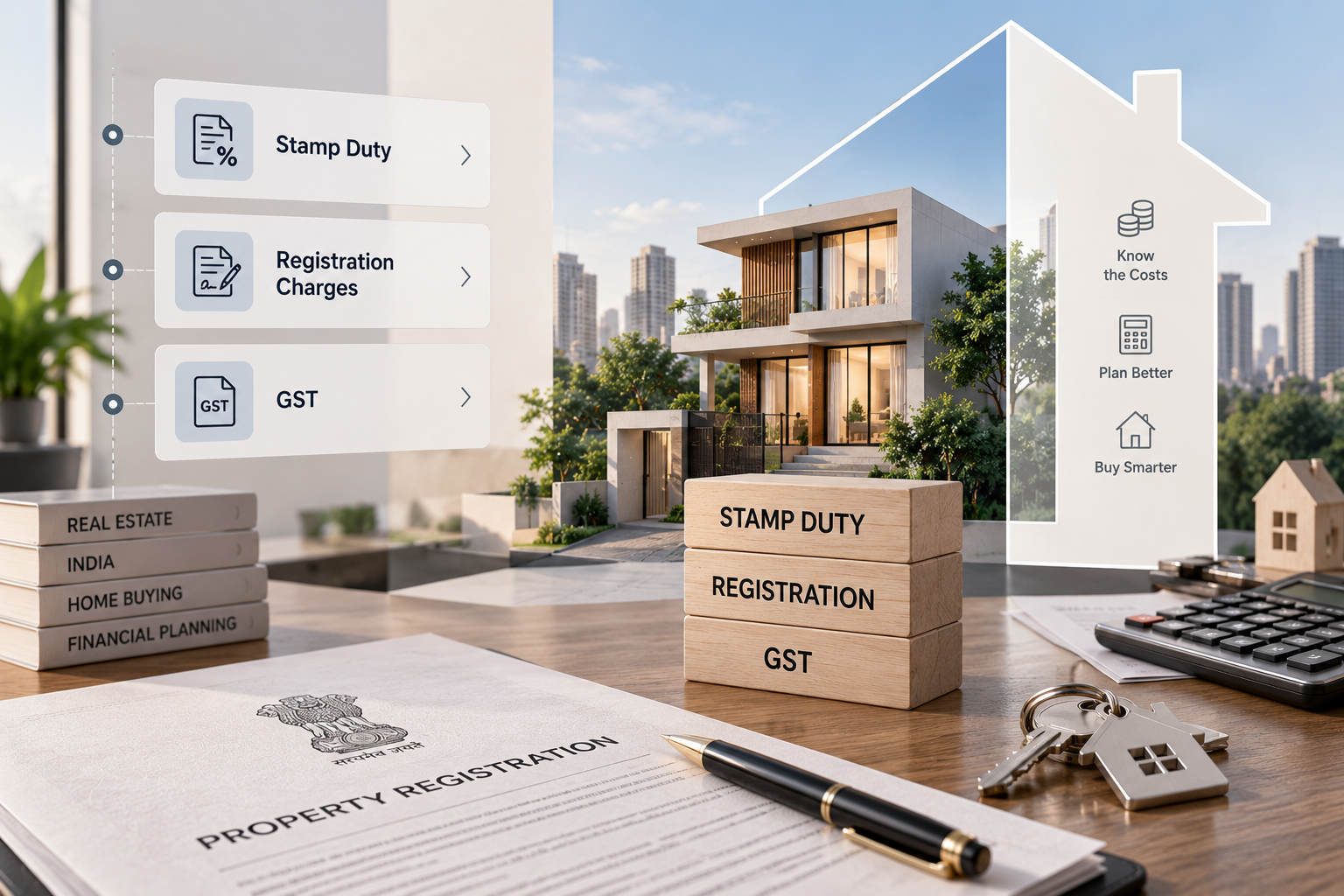
The big three: Stamp duty, registration, and GST
These are the largest closing costs. They are mandatory. You cannot negotiate them.
1. Stamp duty
This is a state tax on property transactions. The rate varies by state and sometimes by city.
Typical rates:
- Maharashtra: 5-7% (lower for women buyers)
- Karnataka: 5%
- Delhi: 6%
- Tamil Nadu: 7%
- Uttar Pradesh: 7%
Example: You buy a ₹80 lakh flat in Bangalore. Stamp duty at 5% = ₹4,00,000.
Who pays: The buyer.
When you pay: At the time of registration.
2. Registration fee
This is the fee to register the property in your name with the sub-registrar office.
Typical rate: 1% of the property value (capped at ₹30,000 in some states).
Example: ₹80 lakh property. Registration at 1% = ₹80,000 (or ₹30,000 if capped).
Who pays: The buyer.
When you pay: At the time of registration.
3. GST (for under-construction properties)
If you are buying an under-construction property, you pay GST on the property value (excluding the land cost).
Rate: 5% (with input tax credit) or 1% (for affordable housing).
Example: ₹80 lakh property. Construction cost is 70% (₹56 lakhs). GST at 5% = ₹2,80,000.
Note: If you are buying a ready-to-move-in property (completion certificate issued), there is no GST.
Who pays: The buyer.
When you pay: In installments as construction progresses.
The smaller costs (that add up)
4. Loan processing fee
The bank charges a fee to process your home loan application.
Typical rate: 0.5-1% of the loan amount (plus GST).
Example: ₹60 lakh loan. Processing fee at 0.5% = ₹30,000 + GST (₹5,400) = ₹35,400.
Who pays: The borrower.
When you pay: When the loan is disbursed.
5. Legal fees
You need a lawyer to verify the property documents (title deed, encumbrance certificate, building approvals).
Typical cost: ₹20,000-₹50,000 (depending on the property value and complexity).
Who pays: The buyer.
When you pay: Before signing the sale agreement.
6. Home inspection fee
If you are buying a resale property, you might want to hire an inspector to check for structural issues, plumbing, electrical wiring, etc.
Typical cost: ₹5,000-₹15,000.
Who pays: The buyer.
When you pay: Before finalizing the deal.
7. Maintenance deposit
Most housing societies require a one-time maintenance deposit (refundable when you sell).
Typical cost: ₹50,000-₹2,00,000 (depending on the society).
Who pays: The buyer.
When you pay: At the time of possession.
8. Brokerage (if applicable)
If you used a broker to find the property, you pay a commission.
Typical rate: 1-2% of the property value.
Example: ₹80 lakh property. Brokerage at 1% = ₹80,000.
Who pays: Usually the buyer (sometimes split with the seller).
When you pay: When the deal is finalized.
9. Interior and moving costs
This is not a "closing cost," but you need to budget for it.
Typical cost:
- Basic interiors (painting, flooring, kitchen): ₹5-10 lakhs
- Moving and packing: ₹10,000-₹30,000
The total: How much to budget
Let's calculate the total closing costs for a ₹80 lakh property in Bangalore (under-construction).
- Cost — Amount
- Property price — ₹80,00,000
- Stamp duty (5%) — ₹4,00,000
- Registration (1%) — ₹80,000
- GST (5% on 70% of value) — ₹2,80,000
- Loan processing fee (0.5% + GST) — ₹35,400
- Legal fees — ₹30,000
- Maintenance deposit — ₹1,00,000
- Brokerage (1%) — ₹80,000
- Total closing costs — ₹9,05,400
Total amount needed: ₹80,00,000 + ₹9,05,400 = ₹89,05,400
If you only budgeted for the ₹80 lakh property price, you are ₹9 lakhs short.
How to estimate your closing costs (step-by-step)
Step 1: Check the stamp duty rate in your state
Google "[Your state] stamp duty rate" or check the state government website.
Multiply the property price by the stamp duty rate.
Step 2: Add 1% for registration
In most states, registration is 1% of the property value (capped at ₹30,000 in some states).
Step 3: Check if GST applies
If the property is under-construction, you pay GST. If it is ready-to-move-in, you do not.
For under-construction, assume GST is 5% of 70% of the property value (unless it is affordable housing, then 1%).
Step 4: Add 1% for loan processing and legal fees
This is a rough estimate. The actual cost depends on your bank and lawyer.
Step 5: Add ₹1-2 lakhs for miscellaneous costs
Maintenance deposit, brokerage, home inspection, etc.
Total closing costs: Roughly 8-12% of the property price (depending on the state and whether GST applies).
How to reduce closing costs
1. Buy in a state with lower stamp duty
If you are flexible on location, check stamp duty rates in nearby states or cities.
Example: Stamp duty in Noida (UP) is 7%. Stamp duty in Gurgaon (Haryana) is 7%. But stamp duty in some smaller cities is lower.
2. Register the property in a woman's name
Many states offer a 1-2% discount on stamp duty if the property is registered in a woman's name (or jointly with a woman as the first owner).
Example: Maharashtra offers a 1% discount for women. On a ₹80 lakh property, that is ₹80,000 saved.
3. Buy a ready-to-move-in property
You avoid GST if the property has a completion certificate. This can save you 3-5% of the property value.
4. Negotiate the brokerage
Brokerage is negotiable. If the broker is asking for 2%, try to negotiate it down to 1% or 0.5%.
5. Shop around for loan processing fees
Some banks charge 1%, others charge 0.25%. Compare before you apply.
Some banks waive the processing fee during promotional periods. Ask.
Common mistakes
Not budgeting for closing costs. People save for the down payment but forget about the extra 8-10% for closing costs. Then they are forced to borrow from family or take a personal loan (at high interest).
Assuming the builder will cover GST. The builder does not pay GST. You do. It is added to your total cost.
Not getting a legal opinion. Skipping the lawyer to save ₹30,000 is risky. If there is a title dispute later, you could lose the entire property.
Paying brokerage without a written agreement. Always get a written agreement with the broker stating the commission rate. Otherwise, they might demand more at the last minute.
When this won't help
This advice is for people buying a property in India.
It will not help if:
- You are buying agricultural land. The rules and costs are different.
- You are buying a commercial property. GST and stamp duty rates are different.
- You are inheriting or receiving a property as a gift. Different taxes apply.
Conclusion
Closing costs are not optional. They are not negotiable (except brokerage). They are a mandatory part of buying a home.
If you are planning to buy a ₹80 lakh property, budget for ₹88-90 lakhs total. Do not assume the property price is the final price.
Run the numbers before you start house hunting. Know exactly how much you need. Then save accordingly.
Next step: Use the formula above to estimate your closing costs. Add 10% to the property price as a rough estimate. Make sure you have that amount saved before you start looking at properties.
Frequently asked questions
Curious what this means for your loan?
Get a free, no-pressure savings report in about 60 seconds.