Pre-Approved vs Pre-Qualified Loan: Why You Can Still Get Rejected (2026)
That 'pre-approved' loan offer might not be approved at all. Learn the difference between marketing offers and real credit offers to avoid rejection.
Priyanka Soni
9 Jul 2026
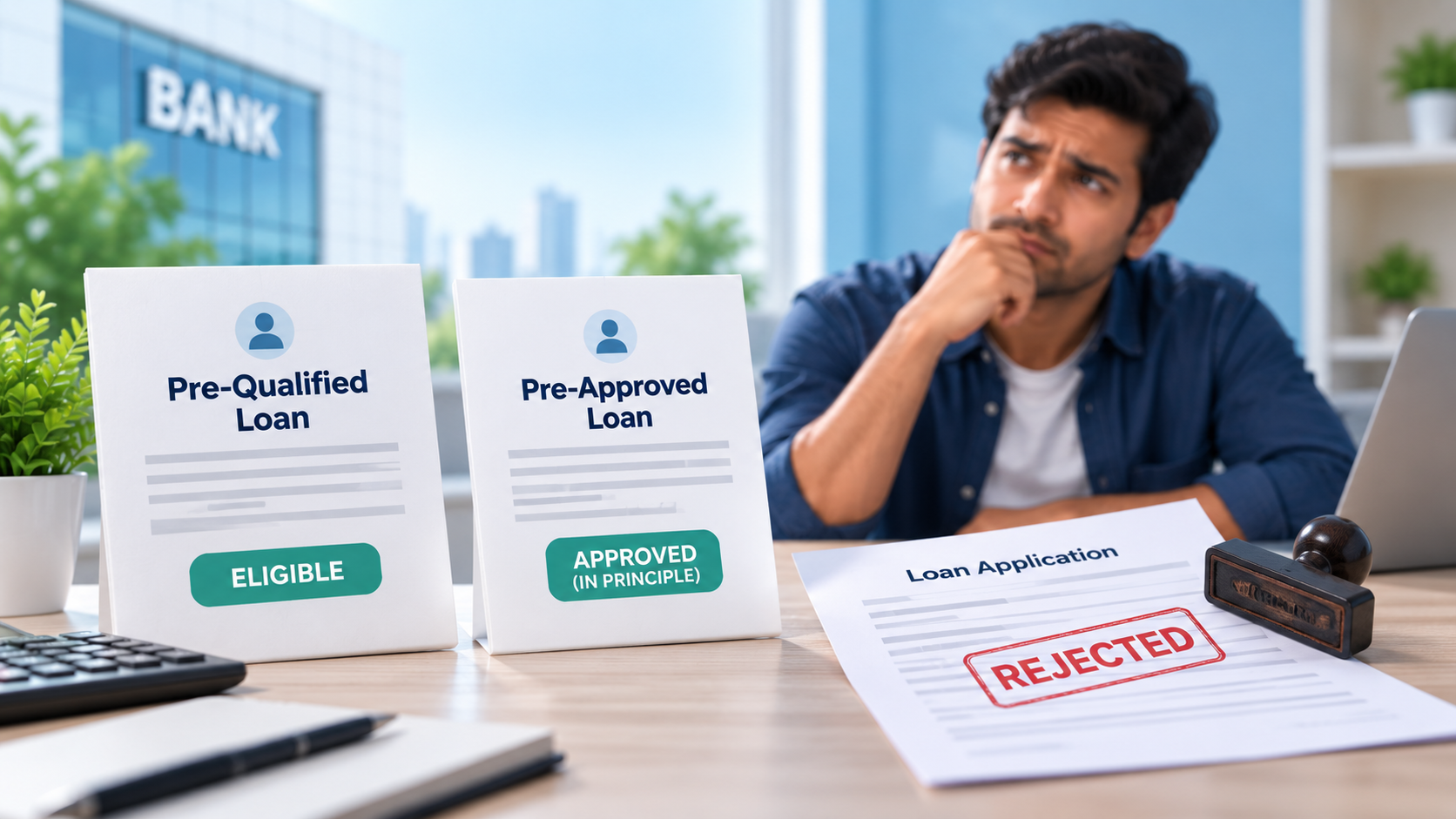
You get an SMS: "Congratulations! You are pre-approved for a personal loan of ₹5 lakhs at 10.99%. Apply now!"
You click the link. Fill out the form. Submit documents. Wait three days.
Then you get another message: "We regret to inform you that your loan application has been rejected."
Wait. Pre-approved means approved, right? How can a pre-approved loan get rejected?
Because "pre-approved" does not mean what you think it means. And neither does "pre-qualified."
Here is the difference between these two terms, how banks use them to get you to apply, and how to avoid wasting your time (and your credit score) on offers that were never real.
What "pre-qualified" actually means
Pre-qualified is a marketing term. It means the bank thinks you might be eligible based on very basic information.
They looked at:
- Your age
- Your city
- Your employer (if they have a tie-up with your company)
- Maybe your credit score (if they did a soft inquiry)
They did not check:
- Your actual income
- Your existing loans
- Your credit utilization
- Your employment stability
Translation: "You fit our target demographic. We want you to apply. But we have not actually checked if you qualify."
Example
You work at Infosys. The bank has a partnership with Infosys. They send a "pre-qualified" offer to all Infosys employees earning above ₹50,000.
You apply. But when they check your credit report, they see you have three maxed-out credit cards and a personal loan you are struggling to pay.
Rejected.
The "pre-qualified" offer was just a way to get you to apply. It was not a guarantee.
What "pre-approved" actually means
Pre-approved is supposed to mean the bank has already checked your credit profile and decided you are eligible.
They looked at:
- Your credit score
- Your existing relationship with the bank (salary account, credit card, etc.)
- Your repayment history
- Your income (if you have a salary account with them)
Translation: "We have done our homework. You are very likely to get approved if you apply."
But here is the catch: "Very likely" is not the same as "guaranteed."
Even a pre-approved offer can get rejected if:
- Your income has dropped since they checked.
- You took on new debt recently.
- You missed a payment on another loan.
- You provided incorrect information in the application.
Example
You have a salary account with HDFC. You have been banking with them for five years. Your salary is ₹1,20,000. You have a credit card with them that you always pay on time.
HDFC sends you a "pre-approved" personal loan offer for ₹10 lakhs.
You apply. They verify your current salary slip and bank statements. Everything checks out. Approved.
This is a real pre-approved offer. The bank already knew you were a good customer. They just needed to confirm nothing had changed.
The key difference
- Feature — Pre-Qualified — Pre-Approved
- Credit check done? — No (or soft inquiry only) — Yes (soft or hard inquiry)
- Income verified? — No — Usually yes (if you bank with them)
- Approval chances — 30-50% — 70-90%
- Marketing or real offer? — Marketing — Real (but not guaranteed)
- Should you apply? — Only if you actually need it — Yes, if you need it
How to tell if an offer is real
1. Check who sent it
Your own bank (where you have a salary account): Likely real. They have your income data.
A bank you have never used: Probably marketing. They do not know anything about you.
A third-party app or website: Definitely marketing. They are just trying to get you to apply so they can earn a commission.
2. Look for specific numbers
Real offer: "You are pre-approved for ₹5,00,000 at 10.99% for 3 years."
Marketing offer: "You may be eligible for a loan up to ₹10 lakhs. Apply to check your rate."
If the offer says "up to" or "check your eligibility," it is not pre-approved. It is an ad.
3. Check if they ask for documents
Real pre-approved offer: You click "Accept Offer" and the money is in your account in 24 hours. Minimal or no documents needed.
Fake pre-approved offer: You click "Apply Now" and they ask for salary slips, bank statements, PAN card, Aadhaar, and then they say "We will review and get back to you."
If they need to "review," it was never pre-approved.
Why banks do this (and why it hurts you)
Banks send millions of "pre-qualified" and "pre-approved" messages because it works. People see "approved" and feel special. They apply.
Even if only 10% of applicants actually get the loan, the bank still made money.
But here is the problem for you:
Every application is a hard inquiry. Even if you get rejected, the inquiry stays on your credit report for two years — see Credit Hungry for exactly how repeated hard inquiries compound against your CIBIL score.
If you apply for five "pre-approved" loans and get rejected for all of them, your credit score drops 30-50 points. Future lenders see those rejections and assume you are desperate or risky.
You are stuck in a loop: You apply because you need credit. You get rejected. Your score drops. You apply again. Rejected again. Score drops more.
How to apply without tanking your score
1. Use eligibility checkers first
Most banks have an "eligibility calculator" on their website. You enter your income, existing loans, and credit score. It tells you if you are likely to get approved.
This is a soft inquiry. It does not affect your credit score.
Only apply if the checker says you have a high chance of approval.
2. Apply to your own bank first
If you have a salary account or a credit card with a bank, apply there first. They already have your data. Your approval chances are much higher.
3. Do not apply to multiple banks at once
If you apply to five banks in one week, each one does a hard inquiry. Your score drops with each inquiry.
Apply to one bank. Wait for the result. If rejected, wait 3-6 months before applying elsewhere.
4. Read the fine print
Before you click "Apply Now," read the terms. Look for phrases like:
- "Subject to credit approval"
- "Final rate and amount may vary"
- "Offer valid for select customers"
If you see these, the offer is not guaranteed.
A real example: Rohan's mistake
Rohan got an SMS from three banks in one week. All said "pre-approved personal loan."
He needed ₹3 lakhs for a medical emergency. He applied to all three, thinking he would pick the best rate.
Bank A: Rejected (income too low).
Bank B: Rejected (too many recent inquiries).
Bank C: Rejected (same reason).
His credit score dropped from 760 to 710. Three hard inquiries in one week.
Two months later, he applied for a credit card. Rejected. The bank saw the three recent loan rejections and assumed he was in financial trouble.
If Rohan had used an eligibility checker first, he would have known his income was too low for the loan amount. He could have applied for a smaller loan or waited until his income increased.
When this won't help
This advice is for people who are considering applying for a loan or credit card based on a "pre-approved" or "pre-qualified" offer.
It will not help if:
- You have already applied and been rejected. The damage is done. Wait 6 months before applying again.
- You have a very low credit score (under 650). In that case, even real pre-approved offers are rare. Focus on improving your score first.
Conclusion
"Pre-approved" sounds official. It sounds like the bank has already decided to give you the loan. But in most cases, it is just a marketing tactic to get you to apply.
Real pre-approved offers come from banks where you already have a relationship. They have your data. They know you can repay.
Fake pre-approved offers come from banks that know nothing about you. They are fishing for applications.
Before you click "Apply Now," ask yourself: Does this bank actually know my income and credit history? Or are they just guessing?
Next step: If you have a "pre-approved" offer sitting in your inbox, check who sent it. If it is not your own bank, use an eligibility checker before applying.
Frequently asked questions
Curious what this means for your loan?
Get a free, no-pressure savings report in about 60 seconds.