How to Stay Debt-Free After Paying Off Your Credit Card
Cleared your credit card balance? Here's how to avoid sliding back into debt with practical spending and savings habits.
Priyanka Soni
25 Apr 2026
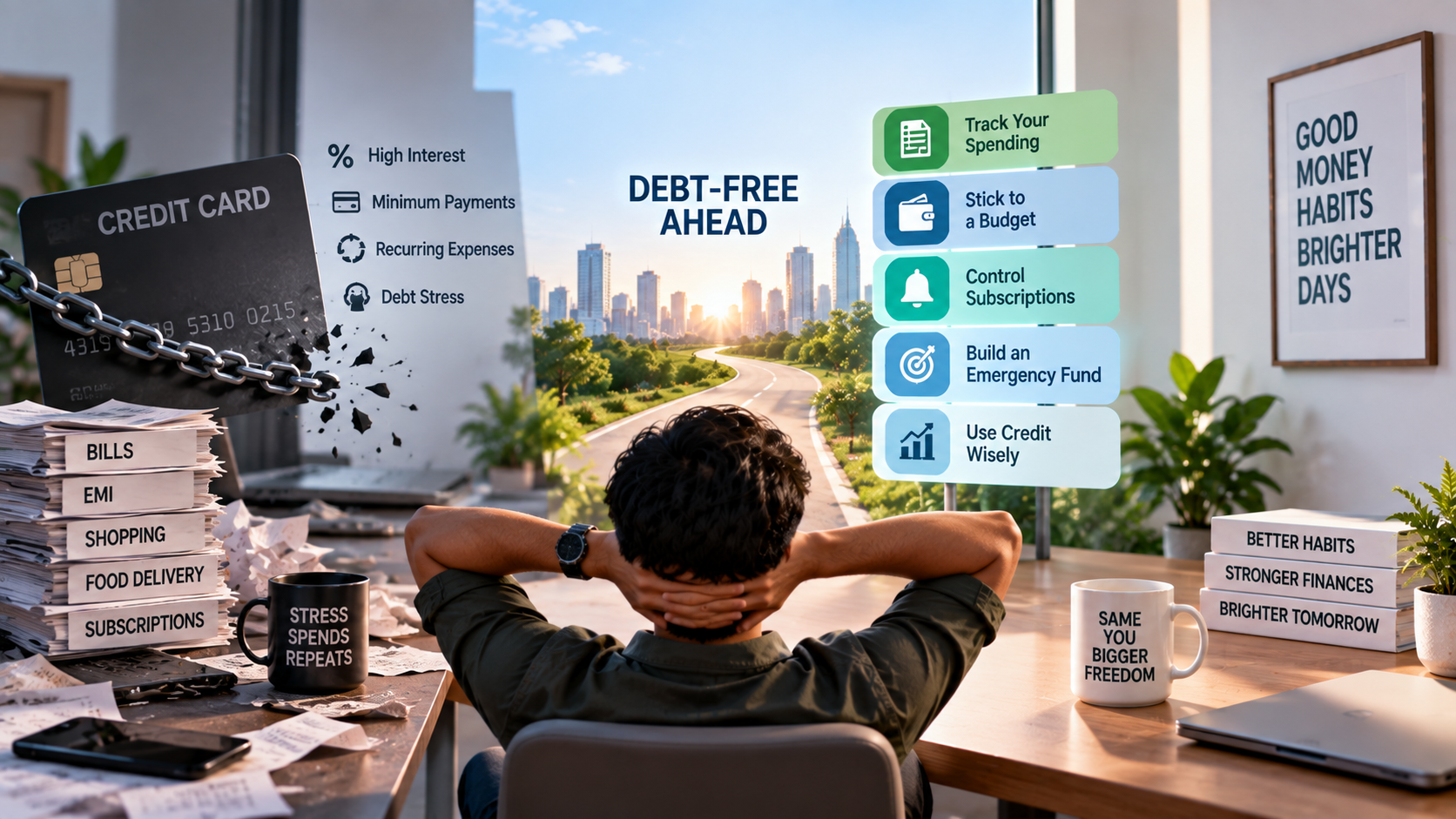
You finally did it. You saw that "Total Amount Due: ₹0.00" on your screen. The weight on your chest is gone.
But here is the part nobody talks about: the dangerous quiet that follows.
Most people think the hard part is paying off the debt. It isn't. The hard part is not sliding back into it three months later. It’s like finishing a strict diet—you’ve lost the weight, you feel great, and suddenly a slice of cake doesn't look like "cheating" anymore. It looks like a reward.
That "I deserve this" feeling is the most expensive emotion you can have.
If you’ve recently cleared a balance, or you’re close to it, you need a plan for the day after you’re free. Because credit card companies are betting you’ll come back. Here is how to prove them wrong.
The psychology of the slide
There is a concept in psychology called the "What-the-Hell Effect." It usually applies to dieting—you eat one cookie, feel you've broken your streak, say "what the hell," and eat the whole box.
Money works the same way.
When you are in debt payoff mode, you are hyper-vigilant. You check every transaction. You say no to dinner plans. You are disciplined.
Once the balance hits zero, that tension snaps. You buy a new pair of shoes. Then a nice dinner. Then you book a flight. It starts small, but because you aren't "in trouble" anymore, your brain relaxes. You stop tracking.
Suddenly, you see a bill for ₹15,000. You pay only ₹5,000 because "cash is tight this month." And just like that, the cycle restarts.
The "richer" illusion
When you were paying ₹10,000 a month toward debt, that money was "gone" before you saw it. Now that you aren't making those payments, it feels like you got a ₹10,000 raise.
You didn’t. You just stopped bleeding. If you absorb that extra cash into your lifestyle (ordering more food, upgrading subscriptions), you aren’t building safety; you’re just building a more expensive life that requires credit to maintain.
4 steps to debt-proof your brain
Willpower is overrated. It fails when you’re tired, stressed, or hungry. Instead of relying on self-control, set up barriers that make it annoying to spend money.
1. The "digital friction" method
The easier it is to pay, the more you spend. Companies spend millions to make checkout seamless (saved cards, One-Tap buy). You need to break that flow.
- Delete saved cards: Go to Amazon, Flipkart, Zomato, and Uber. Delete your credit card details.
- The outcome: Next time you want to impulse buy a gadget at 11 PM, you have to get off the couch, find your wallet, and type in the 16-digit number. That 60 seconds of effort is often enough to make you realize you don't actually need it.
2. Use the "reverse EMI" trick
Remember that monthly payment you used to struggle with? The one that kept you up at night?
Keep paying it. But pay it to yourself.
If you were paying ₹5,000 a month to the bank, set up an automatic recurring deposit (RD) or SIP for ₹5,000 on the same date.
- Why this works: You are already used to living without that money. By diverting it to savings immediately, you prevent lifestyle inflation.
- The math: Investing ₹5,000/month at 12% return grows to about ₹4 lakhs in 5 years. That’s your freedom fund.
3. Set artificial limits
Most banking apps allow you to control your card limits. If your card has a limit of ₹1 Lakh, you don’t need access to all of it every day.
- Open your banking app (HDFC MyCards, ICICI iMobile, CRED, etc.).
- Find "Manage Card" or "Card Controls."
- Set the transaction limit to something low, like ₹5,000 or ₹10,000.
If you try to buy something expensive, the transaction will decline. You’ll get a text. That moment of "Oh right, I blocked this" forces you to pause and think: Do I really want to unlock the app and change the settings for this?
Usually, the answer is no.
4. The 48-hour rule
For any purchase over ₹2,000 that isn't groceries or medicine: wait 48 hours.
Add it to your cart. Close the tab. Set a reminder on your phone.
If you still want it just as badly two days later, go ahead. But 80% of the time, the dopamine rush fades, and you’ll wonder why you wanted it in the first place.
Common mistakes (and hidden traps)
Don't close the card immediately. This is a knee-jerk reaction. "I can't trust myself, so I'll cut it up."
- The problem: Closing an old card shortens your "credit history" and lowers your total available credit limit. Both of these can hurt your credit score (CIBIL).
- The fix: Keep the card, but remove it from your wallet. Put it in a drawer at home. Use it for one small recurring bill (like Netflix) and set up Auto-Pay so it stays active but doesn't tempt you.
Don't ignore the "Minimum Due" trap again. If you do use the card, never look at the "Minimum Due" number. It is a trap designed to keep you in debt for decades. Install an app or widget that only shows "Total Due." If you can't pay the total, you can't afford the purchase.
When this won't help
These psychological tricks work for behavioral debt—spending on things we don't need to feel better.
They won't fix structural problems:
- Medical emergencies: If you swipe your card because someone is in the hospital, that’s not a relapse; that’s survival. You need an emergency fund and health insurance, not app limits.
- Income loss: If you lost your job and are using credit to buy food, you need to cut expenses ruthlessly and find income, not worry about credit scores.
What to do next
Don't just read this and nod. Do these three things right now:
- Open your banking app and lower your per-transaction limit to ₹5,000.
- Delete your card details from one major shopping app you use too much.
- Set up a recurring transfer for the amount you used to pay in debt, moving it to a savings account instead.
Staying debt-free feels boring compared to the rush of buying new things. But that boredom? That’s what peace of mind feels like. Embrace it.
Frequently asked questions
Curious what this means for your loan?
Get a free, no-pressure savings report in about 60 seconds.