
Home Loan Tax Benefits 2026: Save ₹90,000+ Under Section 80C & 24(b)
Claim up to ₹3 lakh in home loan tax deductions under Section 80C and 24(b). See the exact ₹90,000 savings example, the joint-loan hack, and how to claim it in your ITR.
Priyanka Soni
19 Jun 2026
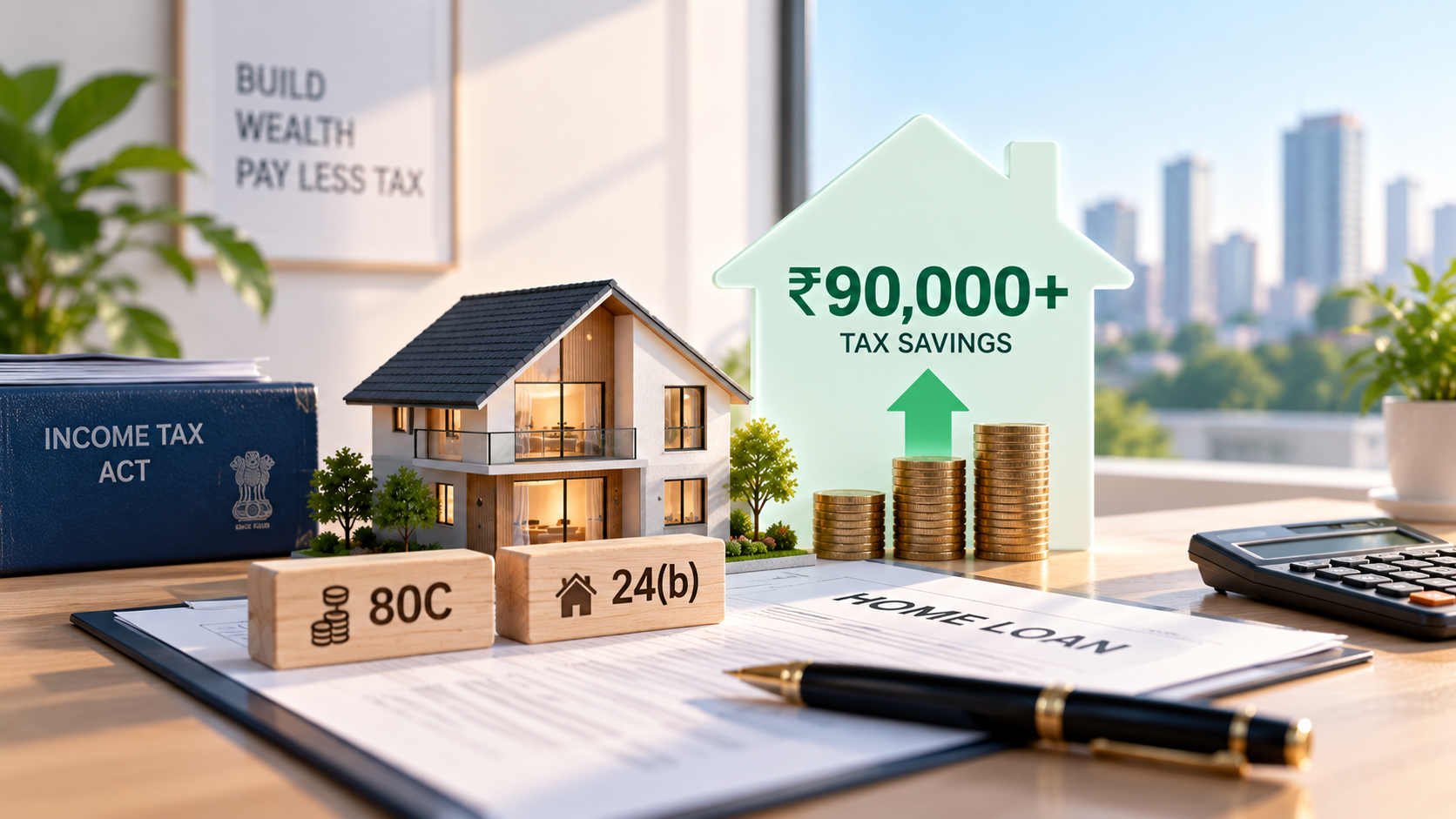
Buying a home in India is strange. You feel proud and terrified at the same time.
The pride comes from owning a roof over your head. The terror comes from the EMI notification that hits your phone on the 5th of every month. For the first few years, that EMI feels like it's eating your entire salary.
But there is a silver lining that many new homeowners ignore. The government actually subsidizes your home purchase through tax breaks. If you structure it right, you aren't just paying a loan; you are lowering your tax bill significantly.
I’m going to walk you through the two main levers: Section 80C and Section 24(b). By the end of this, you’ll know exactly how to claim them and how much money you can keep in your pocket.
The two distinct parts of your EMI
Every EMI you pay has two components:
- Principal: Repaying the actual money you borrowed.
- Interest: The cost of borrowing that money.
The bank sends you an "amortization schedule" (a boring excel sheet) that shows the split. In the early years, you are mostly paying interest. In the later years, you are mostly paying principal.
The Income Tax Act treats these two components differently.
1. Section 80C: The principal repayment
You probably know Section 80C as the bucket for your PPF, ELSS mutual funds, and LIC premiums. But your home loan principal repayment also fits here.
- The Benefit: You can claim a deduction of up to ₹1.5 lakh per financial year.
- The Catch: This ₹1.5 lakh limit is shared with all your other investments. If you already put ₹1.5 lakh into PPF or EPF, you get zero additional benefit from your home loan principal here.
2. Section 24(b): The interest repayment
This is the big one. This deduction is exclusive to homeowners and doesn't collide with your PPF or insurance.
- The Benefit: You can deduct up to ₹2 lakh per financial year from your taxable income for the interest you pay.
- The Condition: The house must be constructed within 5 years of taking the loan.
Let's run the numbers
Theory is boring. Let’s look at a real example to see how much cash this actually saves you.
Imagine you take a home loan with these specs:
- Loan Amount: ₹50 Lakhs
- Interest Rate: 8.5%
- Tenure: 20 Years
- Tax Slab: 30% (Old Regime)
Your EMI is roughly ₹43,400.
In the first year, you will pay the bank about ₹5.2 lakhs total. Here is the split:
- Interest Paid: ~₹4.2 Lakhs
- Principal Paid: ~₹1.0 Lakhs
Here is the tax magic:
- Interest Deduction (24b): You paid ₹4.2L in interest. You can claim the maximum of ₹2 Lakhs.
- Principal Deduction (80C): You paid ₹1L in principal. Assuming you have room in your 80C bucket, you claim the full ₹1 Lakh.
Total Taxable Income Reduced: ₹3 Lakhs.
If you are in the 30% bracket, you just saved ₹90,000 + Cess in taxes. That’s essentially two months of EMIs paid for by the government.
The joint loan hack (Double the benefit)
This is where it gets interesting. If you take the loan jointly with your spouse (and you are both co-owners of the property), both of you can claim these deductions separately.
Using the same example above:
- You claim: ₹2L (Interest) + ₹1L (Principal)
- Spouse claims: ₹2L (Interest) + ₹0 (Principal - since only 1L was paid total)
Total deduction for the family becomes much higher. For a larger loan (say ₹80L or ₹1Cr), where the interest burden is massive, a joint loan is often the only way to cover the full interest cost under the tax umbrella.
Who pays what?
You can't just decide the ratio arbitrarily. The tax benefits must be claimed in proportion to your share in the loan repayment. If you pay 70% of the EMI and your spouse pays 30%, you claim benefits in that exact 70:30 ratio. It helps to have a joint bank account for EMI payments to keep the audit trail clean.
The "New Regime" problem
I have to be the bearer of bad news here. The government is pushing hard for the New Tax Regime.
- Old Regime: You get Section 80C and Section 24(b) benefits.
- New Regime: You generally do not get these benefits for a self-occupied property.
If you switch to the New Regime (which has lower tax rates but fewer deductions), you lose the ability to claim interest and principal deductions on your self-occupied home. This is also the exact deduction that shrinks if you prepay your home loan early — see Home Loan Prepayment vs Investing for the full trade-off.
Exception: If you have rented out the property (let-out property), you can still claim the interest deduction under the New Regime, but there is a catch. You cannot set off "loss from house property" against your salary income beyond a certain point. It gets complicated, so check with a CA if you are renting it out.
The Decision: If you have a home loan, the Old Regime usually beats the New Regime for incomes up to ₹15-20 Lakhs. But you have to do the math every year.
Can you claim HRA and home loan together?
This is the most common question I get. The answer is yes, but with conditions.
If you live in a rented house (because your own home is in another city or too far from work), you can claim both:
- HRA Exemption for the rent you pay.
- Home Loan Benefits (Section 24b and 80C) for the home you own.
However, if you live in your own home, you obviously cannot claim HRA. You can only claim the home loan benefits.
What about the "Pre-Construction" interest?
Real estate in India is notorious for delays. You might pay EMIs for 3-4 years before you even get the keys. What happens to that interest?
You cannot claim it during the construction phase. But you don't lose it.
Once you get possession, you can bundle all that interest paid during the construction years and claim it in 5 equal installments starting from the year of possession. This is over and above the regular interest you pay that year, but the total limit under Section 24(b) still remains capped at ₹2 Lakhs per year (for self-occupied).
Walkthrough: How to claim this
You don’t need to stand in line at a government office. You just need one document.
- Get the Provisional Interest Certificate: Log in to your bank’s app or website around February. Search for "Interest Certificate" or "Tax Certificate".
- Check the split: It will clearly show "Principal expected to be paid" and "Interest expected to be paid" for the current financial year (April to March).
- Submit to HR: If you are salaried, give this to your HR/Finance team in January/February so they adjust your TDS.
- File ITR: When filing your return (usually ITR-1 or ITR-2), put the Interest amount under "Income from House Property" (as a negative value) and Principal amount under "Section 80C".
When this won't help (Common mistakes)
I see people mess this up all the time. Here are the traps:
- Construction not complete: You cannot claim Section 24(b) (interest) or 80C (principal) until the construction is finished and you have possession. If you are paying "Pre-EMI" interest during construction, you have to wait. You can claim that interest in 5 equal installments after you get possession.
- Selling too soon: If you sell the house within 5 years of buying it, the government will reverse all the Section 80C benefits you claimed in previous years and tax you for them.
- The 80C crowd: If your 80C is already full with EPF and ELSS, the principal repayment gives you zero extra tax benefit.
What to do next
Don't let this money slide.
- Download your interest certificate from your loan provider right now.
- Check your tax regime. If you are on the Old Regime, ensure these numbers are in your ITR.
- Calculate the total interest you are paying this year. If it is over ₹2 lakhs, consider if adding a spouse as co-borrower helps (for future loans).
Paying a home loan is a marathon. These tax breaks are the water stations along the way. Drink up.
Frequently asked questions
Curious what this means for your loan?
Get a free, no-pressure savings report in about 60 seconds.

