
No Cost EMI Explained: The Hidden Charges Banks Don't Tell You (2026)
No Cost EMI sounds free, but you pay GST on interest, lose upfront discounts, and pay processing fees. Here's the real math behind the offer.
Priyanka Soni
30 May 2026
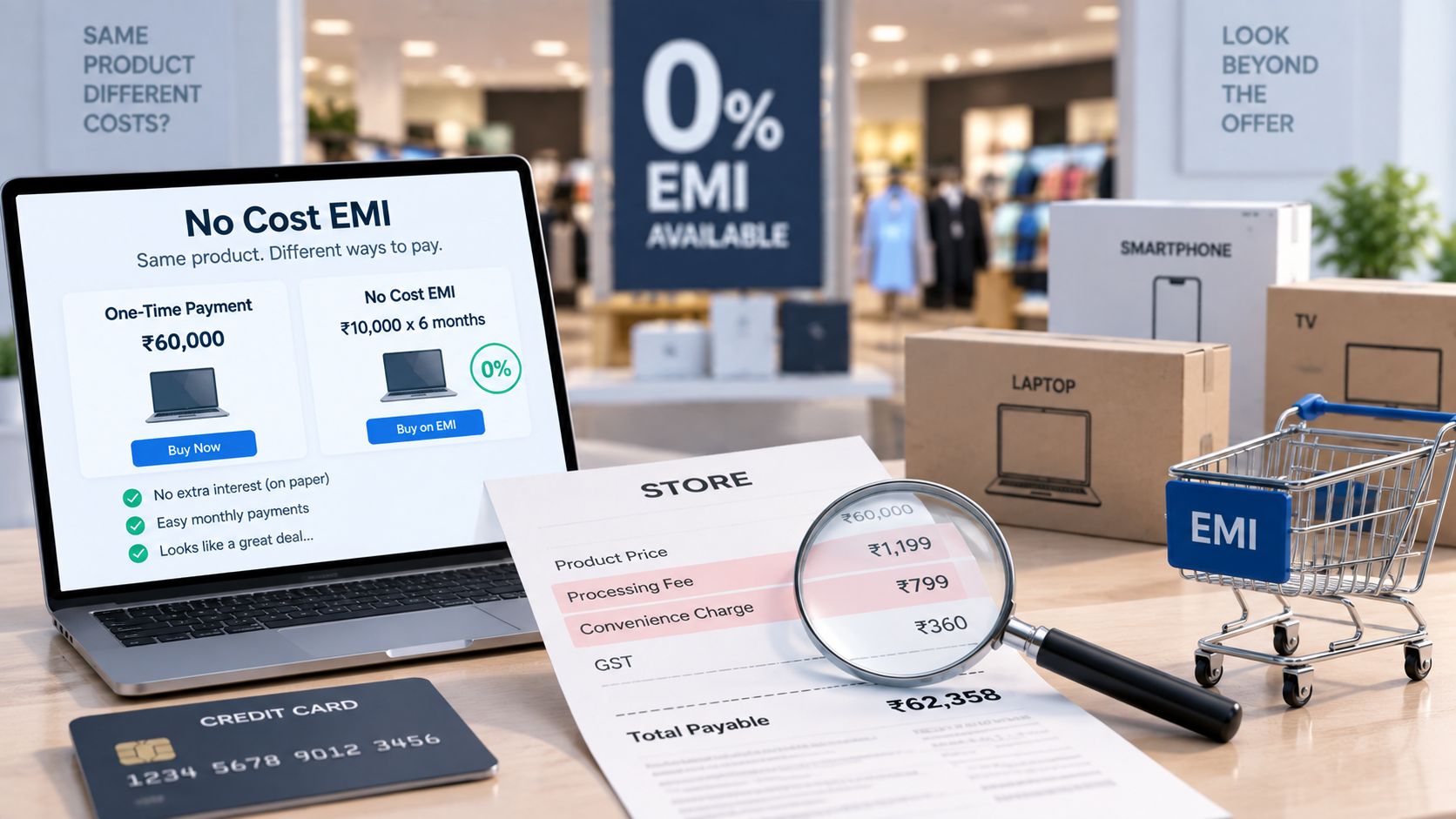
You are buying a laptop for ₹60,000. The website shows two options:
Option A: Pay ₹60,000 now. Get a ₹3,000 instant discount. Final price: ₹57,000.
Option B: No Cost EMI. Pay ₹10,000 per month for 6 months. Total: ₹60,000.
Option B sounds better. You do not have to pay ₹60,000 upfront. You spread it over six months. And it is "No Cost," so you are not paying interest.
But when you check your credit card statement, you see charges you did not expect. Processing fees. GST on interest. And you realize you did not get the ₹3,000 discount.
You paid ₹60,000 + ₹500 in fees. The person who paid upfront paid ₹57,000.
You paid ₹3,500 more for the "No Cost" EMI.
Here is how No Cost EMI actually works, what the hidden costs are, and when it makes sense to use it.
How No Cost EMI works (the bank's version)
When you choose No Cost EMI, here is what happens behind the scenes:
- The bank charges you interest. Let's say 15% per year for 6 months. On a ₹60,000 purchase, that is roughly ₹2,700 in interest.
- The merchant gives you a discount equal to the interest. The merchant reduces the product price by ₹2,700 to offset the interest.
- You pay ₹60,000 total. The interest and the discount cancel each other out.
On paper, it looks like you paid zero interest. But you did not get the discount you would have gotten if you paid upfront.
The hidden costs
1. You lose the upfront discount
Most e-commerce sites offer a discount if you pay the full amount upfront (using a debit card, UPI, or net banking).
Example:
- Laptop price: ₹60,000
- Upfront discount: ₹3,000
- Final price if you pay now: ₹57,000
If you choose No Cost EMI, you do not get this discount. You pay the full ₹60,000.
Hidden cost: ₹3,000
2. GST on the interest
Even though the merchant is paying the interest for you, the government still charges GST on that interest.
The bank charges 15% interest on ₹60,000 for 6 months = ₹2,700.
GST on ₹2,700 at 18% = ₹486.
You have to pay this ₹486, even though the EMI is "No Cost."
Hidden cost: ₹486
3. Processing fee
Some banks charge a processing fee for converting a purchase into EMI. This is usually ₹99 to ₹199.
Hidden cost: ₹99-₹199
4. You cannot return the product easily
If you buy something on No Cost EMI and want to return it, the refund process is messy.
The bank has already paid the merchant. You have to cancel the EMI, which might involve a cancellation fee. The refund can take 2-4 weeks.
If you paid upfront, the refund is instant.
Hidden cost: Time and hassle.
The real math: No Cost EMI vs. Upfront payment
Let's compare the two options for a ₹60,000 laptop.
Option A: Pay upfront
- Product price: ₹60,000
- Upfront discount: ₹3,000
- Final cost: ₹57,000
Option B: No Cost EMI (6 months)
- Product price: ₹60,000
- Upfront discount: ₹0 (you do not get it)
- GST on interest: ₹486
- Processing fee: ₹99
- Final cost: ₹60,585
Difference: ₹3,585 more for No Cost EMI.
You are paying 6.3% more just to spread the payment over six months.
When No Cost EMI makes sense
Despite the hidden costs, there are situations where No Cost EMI is the right choice.
1. You do not have the full amount right now
If you need a laptop for work and you do not have ₹60,000 in your account, No Cost EMI lets you buy it now and pay over time.
Paying ₹3,500 extra is better than not being able to work or missing an opportunity.
2. You can invest the money and earn more
If you have ₹60,000 but you can invest it and earn 12% annual return, it might make sense to keep the money invested and pay EMI instead.
Example:
- You invest ₹60,000 in a mutual fund at 12% for 6 months.
- You earn roughly ₹3,600 in returns.
- You pay ₹3,500 extra for No Cost EMI.
- Net gain: ₹100
This only works if you are disciplined enough to actually invest the money (and not spend it).
3. The upfront discount is small or nonexistent
If the upfront discount is only ₹500 and the No Cost EMI costs you ₹600 extra, the difference is negligible.
In that case, the convenience of paying in installments might be worth it.
4. You are buying something expensive (₹1 lakh+)
For very expensive purchases (like a high-end phone or a TV), the absolute cost difference is larger, but the percentage difference is smaller.
Example:
- Product price: ₹1,50,000
- Upfront discount: ₹5,000
- No Cost EMI hidden costs: ₹1,500
You pay ₹6,500 more for No Cost EMI. But you spread ₹1.5 lakhs over 12 months, which might be easier to manage.
When to avoid No Cost EMI
1. You have the money
If you have ₹60,000 sitting in your savings account earning 3% interest, pay upfront.
You save ₹3,500 by paying now. That is a guaranteed 6% return (better than your savings account).
2. The upfront discount is large
If the upfront discount is ₹5,000 or more, always take it. The No Cost EMI hidden costs are usually ₹500-₹1,000. The upfront discount is worth much more.
3. You are buying something you do not need
If you are buying a gadget just because No Cost EMI makes it "affordable," you are falling into a spending trap.
No Cost EMI is not a reason to buy. It is a payment option for something you already decided to buy.
4. You are already in debt
If you have credit card debt or personal loans, do not add more EMI. Pay off your existing debt first.
How to calculate the real cost
Before you choose No Cost EMI, do this quick calculation:
Step 1: Check the upfront discount. (Let's say ₹3,000)
Step 2: Check the GST on interest. (Usually ₹300-₹500 for a ₹50,000-₹60,000 purchase)
Step 3: Check the processing fee. (Usually ₹99-₹199)
Step 4: Add them up.
Total hidden cost: ₹3,000 + ₹500 + ₹99 = ₹3,599
If this number is more than 5% of the product price, pay upfront.
Common mistakes
Thinking "No Cost" means "Free." It does not. You are paying in other ways (lost discounts, GST, fees).
Not reading the terms. Some No Cost EMI offers have a foreclosure penalty. If you want to pay off the EMI early, you get charged a fee.
Buying things you do not need. No Cost EMI makes expensive things feel affordable. But affordable does not mean necessary.
Not comparing with a regular EMI. Sometimes a regular EMI at 12-14% interest (without losing the upfront discount) is cheaper than No Cost EMI. Run the numbers.
When this won't help
This advice is for people deciding between paying upfront or using No Cost EMI.
It will not help if:
- You have no choice. If you do not have the money and you need the product, No Cost EMI is your only option.
- You are already in default on other loans. In that case, do not add more EMI. Fix your existing debt first.
Conclusion
No Cost EMI is not free. You pay in hidden ways: lost discounts, GST, processing fees.
If you have the money, pay upfront. You will save 3-6% on the purchase.
If you do not have the money, No Cost EMI is a reasonable option. But do not use it as an excuse to buy things you do not need.
Next step: The next time you see a No Cost EMI offer, check the upfront discount. Calculate the hidden costs. Then decide if spreading the payment is worth the extra cost.
Frequently asked questions
Curious what this means for your loan?
Get a free, no-pressure savings report in about 60 seconds.