
Fixed vs Floating Home Loan Interest Rate: Which Should You Choose in 2026?
Should you lock in a fixed rate or bet on floating rates dropping? Learn the math, the risks, and how to decide based on your loan size and tenure.
Priyanka Soni
26 May 2026
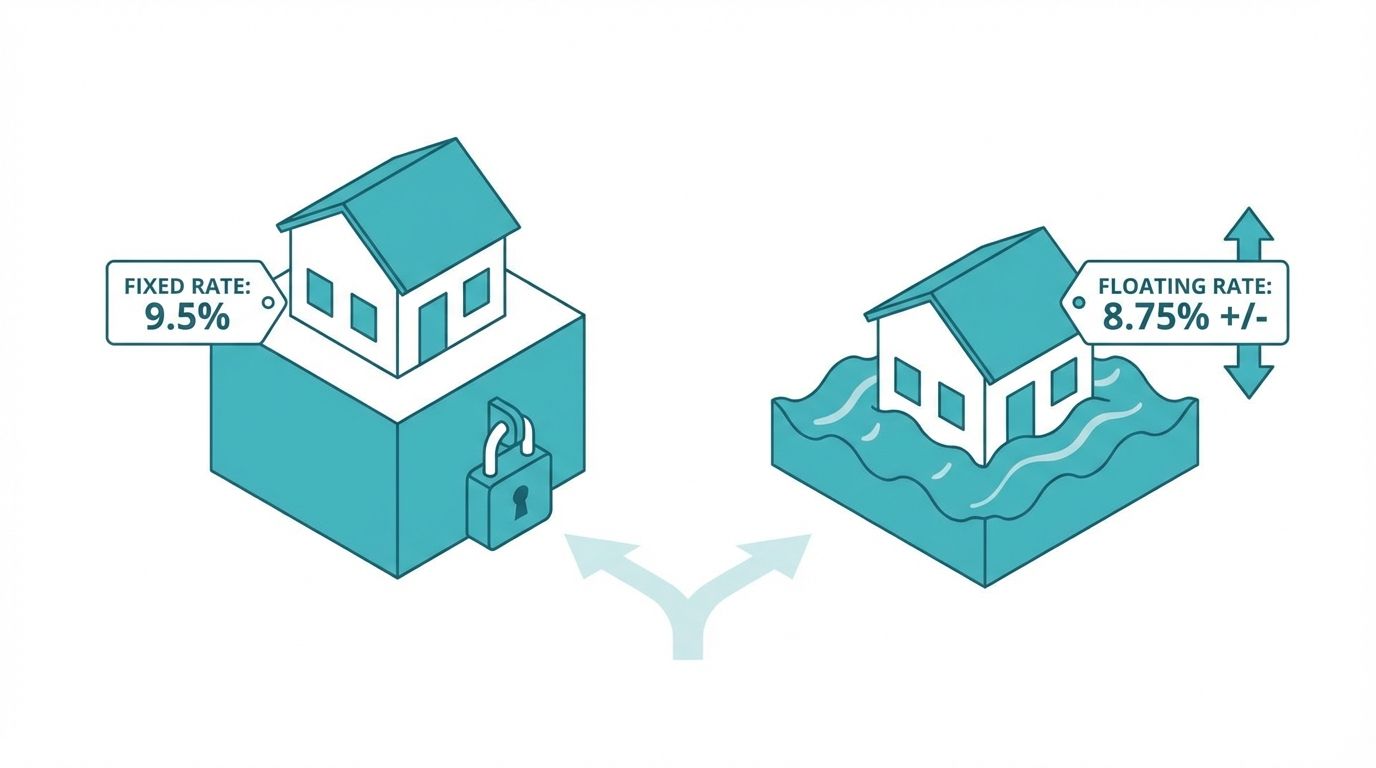
You are about to take a home loan. The bank offers you two options:
Option A: Fixed rate at 9.5% for the entire tenure. Your EMI never changes.
Option B: Floating rate starting at 8.75%. Your EMI can go up or down based on market conditions.
Which one do you pick?
Most people go with floating because it is cheaper right now. But five years later, when rates jump to 10%, they regret it.
Others lock in a fixed rate for peace of mind. But when floating rates drop to 7%, they feel like they overpaid.
There is no universally "correct" answer. But there is a correct answer for your situation.
Here is how to decide based on your loan size, tenure, risk tolerance, and what the interest rate cycle is doing right now.
What is a floating rate?
A floating rate (also called a variable rate) is tied to an external benchmark. In India, most home loans use one of these:
- Repo Rate (set by the Reserve Bank of India)
- MCLR (Marginal Cost of Funds based Lending Rate, set by each bank)
- External Benchmark Lending Rate (EBLR), which is directly linked to the repo rate
When the RBI raises or lowers the repo rate, your bank adjusts your loan rate within a few months. Your EMI goes up or down accordingly.
Example
You take a ₹50 lakh loan at 8.5% floating for 20 years.
- Year 1-3: Rate stays at 8.5%. EMI is ₹43,391.
- Year 4: RBI raises rates. Your loan rate goes to 9.5%. EMI jumps to ₹46,551.
- Year 7: RBI cuts rates. Your loan rate drops to 8%. EMI falls to ₹41,822.
Your EMI is not fixed. It moves with the economy.
What is a fixed rate?
A fixed rate stays the same for a set period (usually 3-5 years, sometimes the entire tenure).
Your EMI does not change, no matter what happens to the repo rate or the economy.
Example
You take the same ₹50 lakh loan at 9.5% fixed for 20 years.
- Year 1-20: Rate stays at 9.5%. EMI is always ₹46,551.
Even if floating rates drop to 7%, you are still paying 9.5%. Even if they jump to 11%, you are still paying 9.5%.
The trade-off: Cost vs. certainty
Floating rate:
- Pros: Usually 0.5-1% cheaper than fixed rates. If rates drop, you save money.
- Cons: If rates rise, your EMI goes up. You cannot predict your future payments.
Fixed rate:
- Pros: Predictable EMI. You know exactly what you will pay every month for the next 20 years.
- Cons: Usually 0.5-1% more expensive. If rates drop, you are stuck paying the higher rate (unless you refinance, which has costs).
When to choose floating
1. You expect interest rates to stay stable or fall
If the RBI has been cutting rates or signaling that inflation is under control, floating rates are likely to stay low or drop further.
In 2020-2021, repo rates were at historic lows (4%). People who took floating rate loans during that period saved a lot of money.
2. You have a long tenure (15-20 years)
Over 20 years, interest rates go through multiple cycles. They rise, they fall, they rise again.
Historically, floating rates average out to be cheaper than fixed rates over long periods. You might pay more in some years, but you will pay less in others.
3. You can handle EMI fluctuations
If your income is stable and you have some buffer in your budget, you can absorb a ₹2,000-₹5,000 increase in your EMI if rates go up.
4. You plan to prepay aggressively
If you plan to close the loan in 5-7 years (by making lump sum prepayments), the interest rate matters less. You are not carrying the loan long enough for rate changes to have a huge impact.
When to choose fixed
1. You expect interest rates to rise
If inflation is high and the RBI is signaling rate hikes, locking in a fixed rate now protects you from future increases.
In 2022-2023, the RBI raised rates six times in a row. People who had fixed rates were insulated. People on floating rates saw their EMIs jump by ₹3,000-₹8,000.
2. You have a tight budget
If your EMI is already 40% of your income, you cannot afford for it to go up. A fixed rate gives you certainty.
You can plan your budget for the next 5-10 years without worrying about surprise EMI hikes.
3. You are risk-averse
Some people just sleep better knowing their EMI will never change. If financial uncertainty stresses you out, the extra 0.5-1% cost of a fixed rate is worth the peace of mind.
4. You have a short tenure (5-10 years)
If you are taking a smaller loan or a shorter tenure, the difference between fixed and floating is smaller in absolute terms.
For a ₹20 lakh loan over 10 years, the difference between 8.5% and 9.5% is about ₹1,200 per month. If you value certainty, that is a reasonable price to pay.
The math: How much does it actually cost?
Let's compare a ₹50 lakh loan over 20 years.
Scenario A: Floating at 8.5%
- EMI: ₹43,391
- Total interest paid: ₹54,13,840
Scenario B: Fixed at 9.5%
- EMI: ₹46,551
- Total interest paid: ₹61,72,400
Difference: ₹7,58,560 more in interest over 20 years.
That is ₹31,607 extra per year, or ₹2,634 extra per month.
But this assumes the floating rate stays at 8.5% for 20 years. In reality, it will move up and down.
If the floating rate averages 9% over 20 years (because of a few years of rate hikes), the difference shrinks to ₹3-4 lakhs.
If the floating rate averages 10%, the fixed rate would have been cheaper.
The hybrid option: Fixed for 3-5 years, then floating
Some banks offer a hybrid structure:
- Years 1-3: Fixed at 9.5%
- Years 4-20: Floating at prevailing rates
This gives you short-term certainty and long-term flexibility.
It is a good middle ground if you are unsure which way rates will move.
How to decide (step-by-step)
Step 1: Check the current rate environment
Go to the RBI website and check the repo rate trend. Is it going up, down, or stable?
If the RBI has been raising rates for the past year, expect more hikes. Consider fixed.
If the RBI has been cutting rates, expect rates to stay low. Go floating.
Step 2: Calculate your EMI buffer
Take your current EMI (at the floating rate). Add 1.5% to the interest rate. Recalculate the EMI.
Can you afford the higher EMI? If yes, floating is safe. If no, go fixed.
Step 3: Check your loan tenure
- 15-20 years: Floating usually wins over time.
- 5-10 years: Fixed is safer if you want certainty.
Step 4: Ask about conversion options
Some banks let you switch from floating to fixed (or vice versa) once during the loan tenure. Ask if this is allowed and what the fee is.
If you can switch later, start with floating. If rates spike, convert to fixed.
Common mistakes
Choosing fixed just because it sounds safer. Fixed is not always safer. If rates drop and you are stuck at 9.5%, you are losing money every month.
Ignoring the reset clause. Some "fixed" rate loans are only fixed for 3-5 years, then they convert to floating. Read the fine print.
Not comparing banks. One bank might offer floating at 8.5% and fixed at 9.5%. Another might offer floating at 8.75% and fixed at 9.25%. Shop around.
Forgetting about prepayment. If you plan to prepay aggressively, the interest rate matters less. Do not stress too much over 0.5%.
When this won't help
This advice is for people taking a new home loan or refinancing.
It will not help if:
- You already have a loan and cannot switch. You are stuck with what you have unless you refinance (which has costs).
- You are taking a very small loan (under ₹10 lakhs). The absolute difference between fixed and floating is tiny. Just pick whichever is cheaper.
Conclusion
There is no "best" choice. There is only the right choice for your situation.
If you can handle uncertainty and expect rates to stay low, go floating.
If you need certainty and expect rates to rise, go fixed.
If you are unsure, ask your bank about a hybrid option or a conversion clause.
Next step: Check the current repo rate. Look at your budget. Calculate how much your EMI would increase if rates go up 1.5%. Then decide.
Frequently asked questions
Curious what this means for your loan?
Get a free, no-pressure savings report in about 60 seconds.

